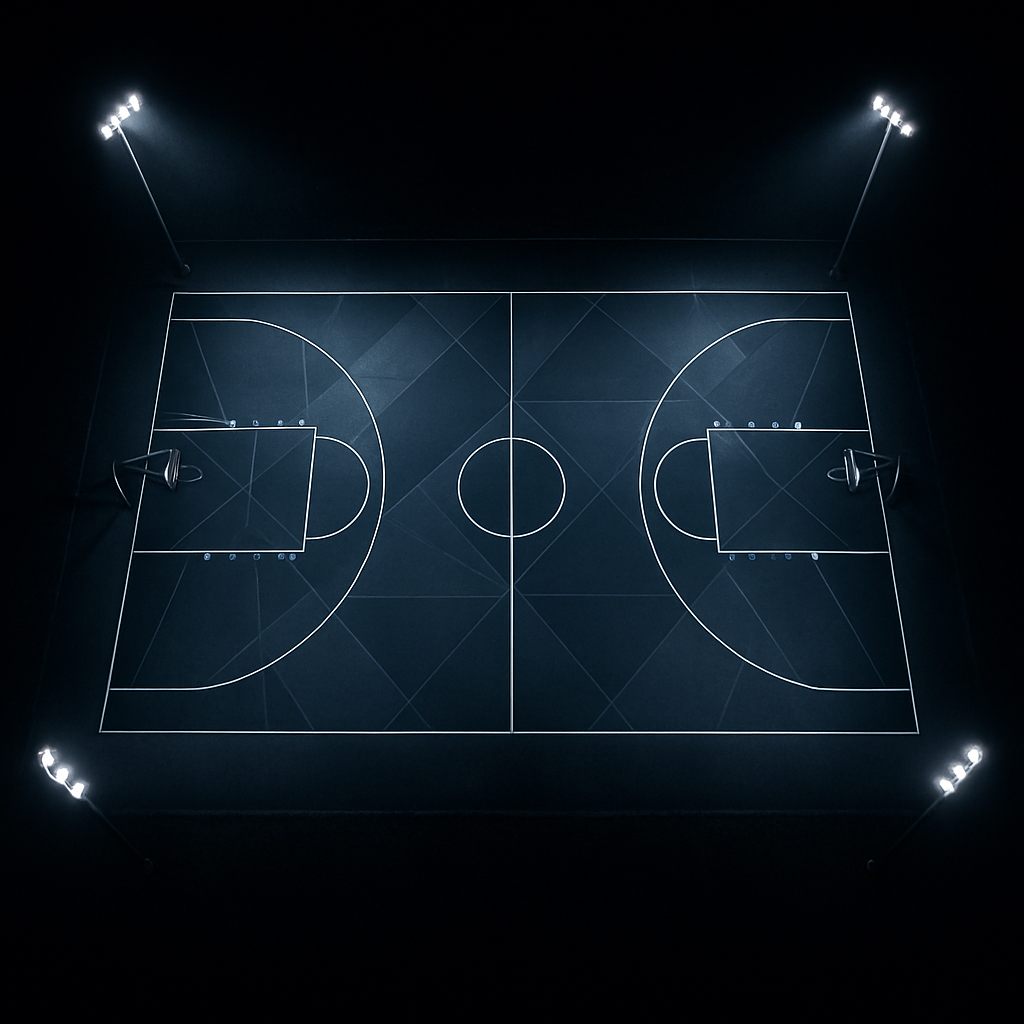
Court vision refers to a player's ability to perceive and process the positions and movements of all other players on the court simultaneously. It is the quality that enables elite playmakers to deliver precise passes to unmarked teammates, often before those teammates are even aware they are open.
Unlike raw athleticism, court vision is a skill that can be developed through structured practice and deliberate attention. The process begins with understanding spacing, which is the principle that offensive players should maintain distances from each other that make it difficult for the defence to guard multiple threats simultaneously.
Players developing court vision should practice scanning the full court before each decision rather than focusing on the immediate vicinity. This habit of wide peripheral observation is central to anticipatory passing and early recognition of defensive rotations.
Pattern recognition is a significant component of reading the game at a high level. Experienced players identify recurring defensive tendencies and positional patterns that signal specific offensive opportunities. A defender consistently sagging off a corner shooter creates a predictable window for a skip pass.
Off ball movement is another dimension of court intelligence. Understanding when to cut to the basket, when to set a screen and when to hold position is as important as knowing what to do with the ball. Players who move purposefully without the ball create the conditions for clean catch and score opportunities.
Film study is an underused tool in developing court vision. Watching recorded games and replays of specific sequences allows players to observe how situations develop over several seconds of play, identifying the moment a defensive gap opens or a passing lane becomes available.
Communication between teammates also sharpens court reading. Verbally signalling positions, screens, mismatches and open spaces during live play creates a shared mental model of the court that accelerates collective decision making.
Ultimately, reading the court is about transforming observation into action under pressure. The highest expression of this skill is the no look pass, where a player accurately delivers the ball to a teammate without directing visual attention toward the target. It is the product of full court awareness and predictive understanding of how play will develop.